
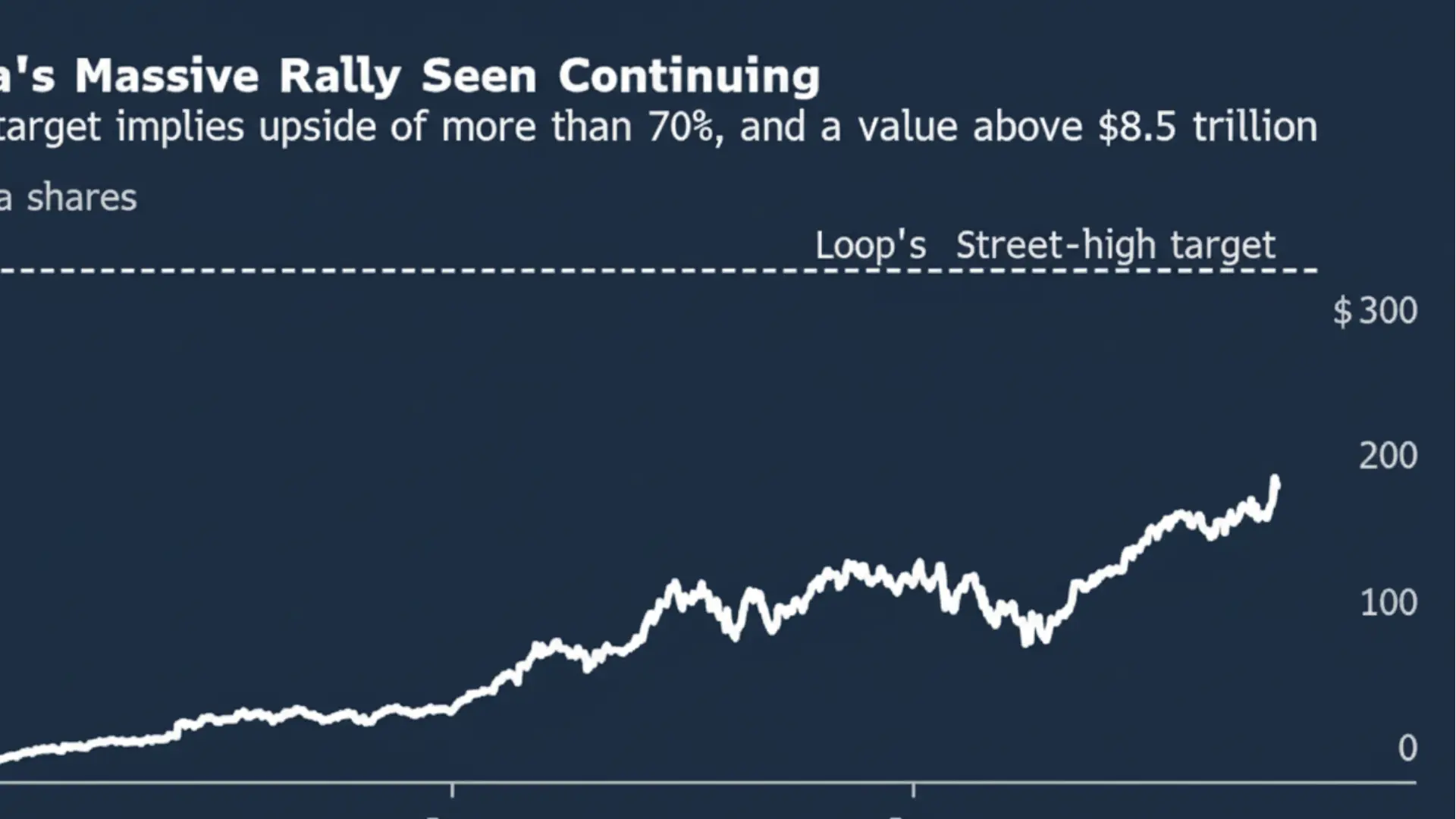
Nvidia has shattered records by becoming the first company to top a $5 trillion market cap, leaving analysts scrambling to pencil in trillions more—like adding extra zeros to a billionaire’s grocery list.
Loop Capital Markets, never ones to undersell a good thing, jacked their price target on Nvidia shares to a lofty $350, up from a mere $250. That’s a 70% pop from the stock’s last close at $202.49, whispering sweet nothings of an $8.5 trillion valuation if it all pans out.
The average Wall Street target? A more modest $231, but who needs average when you’re riding the AI rocket ship?
Pre-market trading perked up 2% on the news, as if the shares themselves woke up with a caffeine jolt. Nvidia’s stock has ballooned over 50% this year alone, outpacing the Philadelphia Semiconductor Index’s 45% sprint—like a cheetah lapping a gazelle in slow motion.
“We are entering the next ‘Golden Wave’ of Gen AI adoption,” proclaimed Loop analyst Ananda Baruah in a note that reads like a surfer’s manifesto. “NVDA is at the front-end of another material leg of stronger-than-anticipated demand.” Translation: Hold onto your surfboards, folks; the AI tsunami is just cresting.
Baruah’s crystal ball shines brightest on Nvidia’s upcoming Blackwell GPU ramp-up. These bad boys are set to double unit shipments over the next 12 to 15 months, all while average selling prices climb like a kid on a sugar rush. It’s the kind of growth that makes accountants giggle in their sleep.
Over at Rosenblatt Securities, they’re not slouching either. They bumped their target to $240 from $215, citing a recent Nvidia shindig that unveiled a jaw-dropping $500 billion-plus in Blackwell orders through 2026. That’s not pocket change; that’s enough to buy a small country’s worth of server farms.
“We continue to be impressed by Nvidia’s AI platform rapidly expanding into other markets beyond the hyperscale data centers,” gushed analyst Kevin Cassidy. Imagine: AI chips not just powering cloud behemoths, but sneaking into your smart toaster, whispering recipe tips with a silicon smirk.
This bullish frenzy bubbles up just in time for Nvidia’s earnings reveal on November 19. Last week’s megacap tech reports from the usual suspects—Microsoft, Meta, Alphabet, and Amazon—painted a picture of unbridled AI enthusiasm. These titans are shoveling cash into Nvidia’s coffers like it’s an all-you-can-eat buffet, with no signs of indigestion.
One can’t help but chuckle at the sheer velocity. Nvidia, once a plucky graphics card maker for gamers dodging lag in virtual battlefields, now commands a war chest that could fund a moon base. Or, more practically, keep the AI hype train chugging without derailing into “bubble” territory—though skeptics might quip it’s more hot air than helium.
Yet the optimism feels as solid as a Blackwell chip: Hyperscalers aren’t flinching from their AI splurges, even as energy bills spike like a bad blind date. Microsoft’s cloud dreams, Meta’s metaverse mirages, Alphabet’s search sorcery, and Amazon’s everything-store empire all hinge on Nvidia’s silicon wizardry.
Baruah’s “Golden Wave” quip? It’s got legs. Picture fleets of data centers humming like overcaffeinated beehives, each buzzing with Blackwell’s promise of double the output at premium prices. Shipments doubling sounds efficient, until you realize it means twice the e-waste for future archaeologists to puzzle over.
Cassidy’s nod to non-hyperscale adventures adds spice. AI infiltrating edge devices? Soon your fridge might negotiate grocery deals autonomously, crediting Nvidia for not letting the milk spoil in peace.
As November 19 looms, investors fidget like kids before a candy haul. Will earnings confirm the trillion-dollar tease, or serve humble pie? For now, Nvidia’s valuation balloon floats higher, buoyed by analysts who see no ceiling—just endless blue skies dotted with dollar signs.
The street’s average target lags at $231, a reminder that not everyone’s aboard the express elevator. But with $500 billion in orders locked in, it’s hard to bet against the chip champ turning skeptics into believers, one upgraded forecast at a time.
In this AI arms race, Nvidia isn’t just winning; it’s lapping the field with a grin. Who knew pixels could pay off so handsomely?




Leave a Reply