
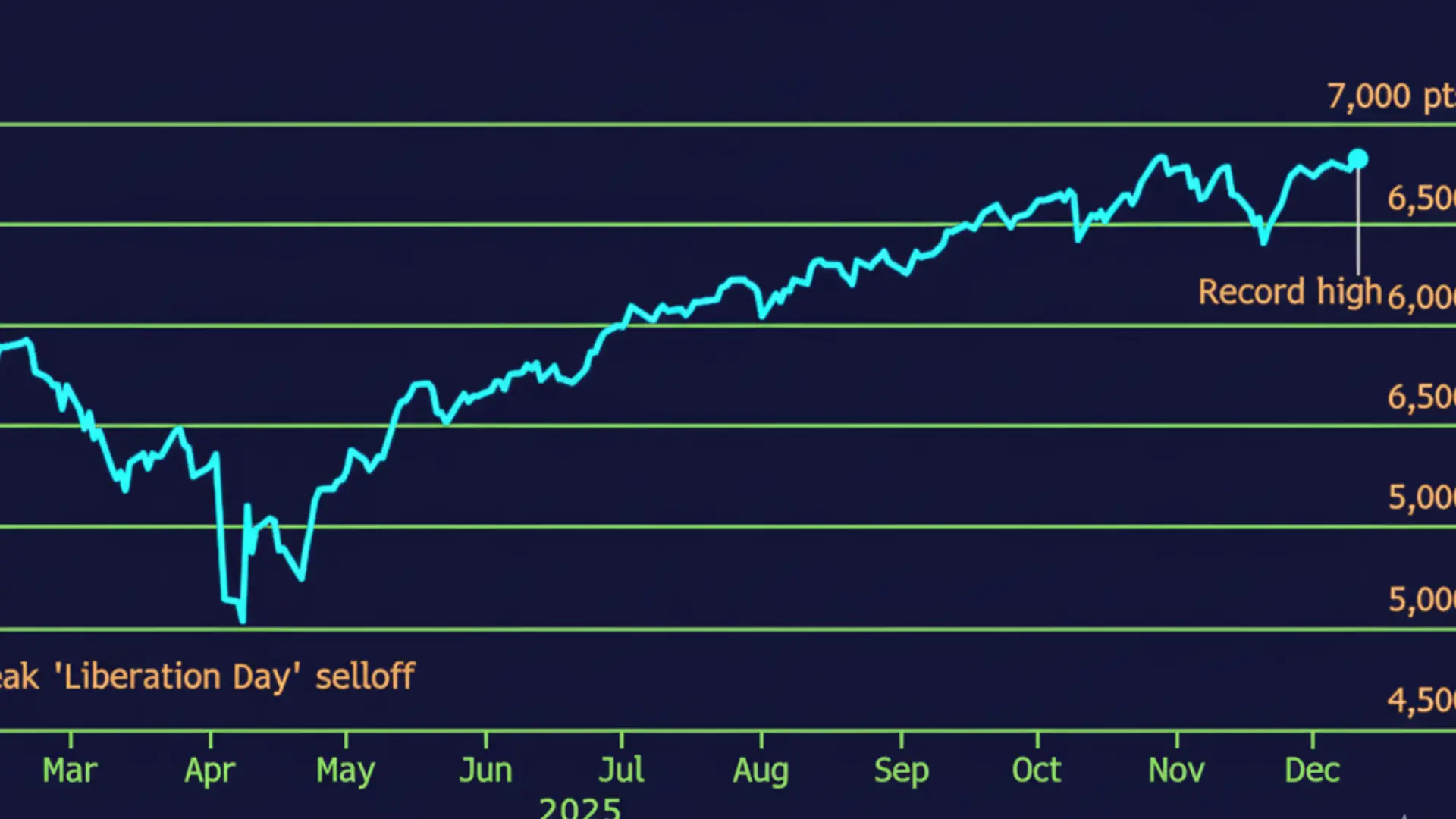
Wall Street’s crystal ball just got a fresh polish: Goldman Sachs says US stocks are headed for new record highs in 2026, fueled by corporate earnings growing faster than a teenager’s phone bill and artificial intelligence finally earning its keep.
The prophecy comes courtesy of incoming chief US equity strategist Ben Snider, who is sliding into David Kostin’s chair with the smooth confidence of someone who already knows the ending. His team forecasts S&P 500 earnings per share leaping 12% next year, with AI chipping in a modest yet photogenic 0.4 percentage points—think of it as the intern who mostly fetches coffee but occasionally nails the presentation.
Snider’s official target: 7,600 on the S&P 500 by the end of 2026, a tidy 10% climb from today’s levels. Translation for normal humans: your 401(k) might finally outpace inflation and your cousin’s crypto bragging.
The rest of the forecasting choir is happily humming the same tune. Morgan Stanley, Deutsche Bank, and RBC Capital Markets have all issued similar “to-the-moon” calls, each predicting gains north of 10%. Somewhere, a Bloomberg survey of global money managers revealed they’re piling into stocks with the enthusiasm usually reserved for free buffet lines.
Yet whispers of an AI bubble persist, because nothing says “mature market” like spending hundreds of billions training computers to write slightly better limericks. Goldman gently waves off the worry, noting that large companies are actually figuring out how to use the tech while smaller firms are still trying to spell “generative.”
The Magnificent Seven—Nvidia, Apple, Microsoft, Alphabet, Amazon, Broadcom, and Meta—remain the cool kids hogging the growth. These seven alone are expected to deliver nearly half of the entire index’s profit gains next year, proving once again that in American capitalism, the rich do indeed get richer, but at least they throw good parties.
Tech’s dominance is now so complete that the S&P 500 is basically the Magnificent Seven plus 493 nervous plus-ones hoping not to get cut from the guest list. Analysts tracked by Bloomberg Intelligence see the fabulous septet posting an 18% profit surge in 2026, while the other 493 companies collectively manage a respectable but far less Instagram-worthy 14%.
Tariffs are expected to fade into background noise, much like that one uncle who promised to fix the economy at Thanksgiving. Combine that with resilient growth and companies finally squeezing actual productivity out of their AI toys, and Goldman sees clear sailing ahead.
Of course, markets have been wrong before—usually right after someone used the phrase “this time is different”—but for now the mood on the Street is less “cautious optimism” and more “cautious champagne.”
So there you have it, folks: 2026 is shaping up to be the year your index fund finally pays for the vacation, provided the robots keep working and nobody asks them to do anything too complicated.






Leave a Reply