
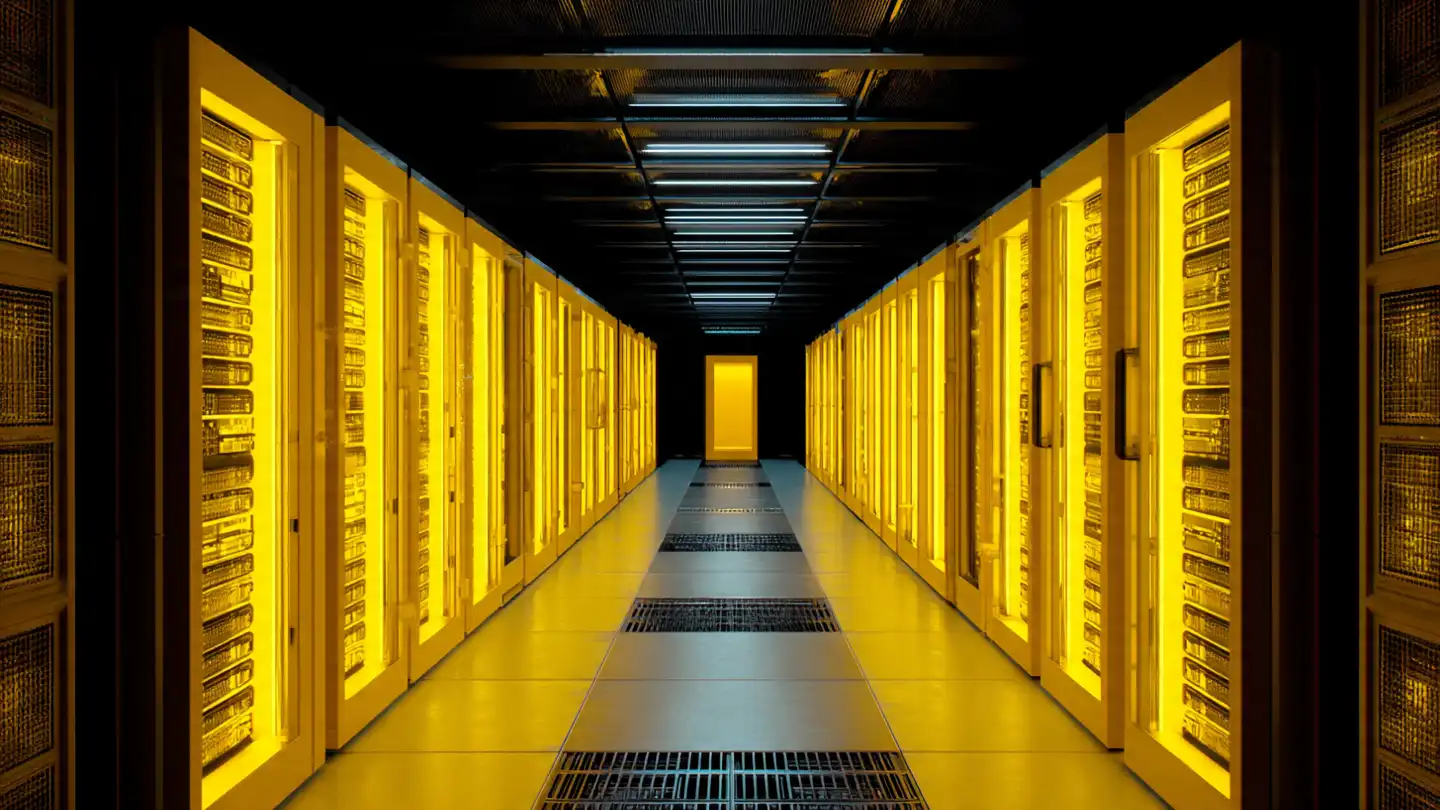
NEW YORK — The U.S. economy grew respectably in the first half of 2025, and according to JPMorgan Asset Management, roughly two-thirds of that growth came not from the spending of 330 million Americans but from a handful of companies buying enough chips and data centers to power a medium-sized country.
In a historic first, artificial intelligence has officially outspent the entire consumer population.
The revelation has Wall Street doing what it does best: quietly panic-buying energy drinks while loudly insisting everything is fine.
Corporate America has responded the way it always does when a shiny new technology appears—by writing checks large enough to make small nations blush. Data centers the size of Costco warehouses now dot the landscape, humming along on power bills that could fund several Mars missions.
Nvidia, the company happily selling the digital shovels for this gold rush, briefly became the most valuable company on Earth, proving once again that in a bubble the pickaxe sellers always win.
Yet a gentle question hovers over the trillion-dollar bonfire: will anyone actually make money from the finished product?
OpenAI’s ChatGPT now boasts 800 million weekly users, a number that would make most app developers weep with joy. Meta, with roughly four times that many monthly users across its apps, recently cleared $50 billion in a single quarter. OpenAI is on pace for perhaps $13 billion in all of 2025. The math, as the kids say, is not mathing.
Company executives remain unfazed. CFO Sarah Prior told CNBC the revenue outlook is “steeply growing,” while CEO Sam Altman upgraded that description to “well more revenue than that.” Investors nodded sagely, the way one nods when a toddler insists the crayon drawing is definitely a Ferrari.
An MIT study poured cold water on corporate enthusiasm, finding that 95% of businesses that invested in AI have yet to turn a profit—having collectively spent an estimated $40 billion in the process. One can only imagine the PowerPoint decks titled “Transformative Synergy” currently gathering dust in recycling bins.
Venture capitalist Paul Kedrosky summed up the situation with characteristic understatement: “It’s not particularly unusual for a market this early to not be making much profit. Of course, the difference is most markets at this stage aren’t also spending a trillion dollars.”
The scalability problem is particularly delicious. Normal software gets cheaper per user the more popular it becomes. AI, by contrast, gets thirstier. Every clever haiku ChatGPT writes requires another small power plant to stay cool. As one analyst noted, “Every time you prompt an AI model, it eats electricity like a teenager eats free samples at Costco.”
White House AI czar David Sacks warned that a reversal in AI spending could risk recession, adding solemnly, “We can’t afford to go backwards.” Critics gently pointed out that “backwards” might simply mean returning to an economy driven by actual customers.
Professor Gary Marcus predicted on Substack: “It’s not going to be pretty when the music stops.” One assumes the final song will be performed by servers gently overheating in perfect harmony.
For now, optimism and pessimism sit together in the same expensive data center, sharing the same electric bill. Some analysts insist we are in the “early innings.” Others quietly check how much it would cost to convert all those GPU farms into very warm warehouses.
The rest of the country waits patiently to discover whether the largest technology bet in history will ultimately power the future or simply power the air-conditioning for a very large, very optimistic experiment.






Leave a Reply