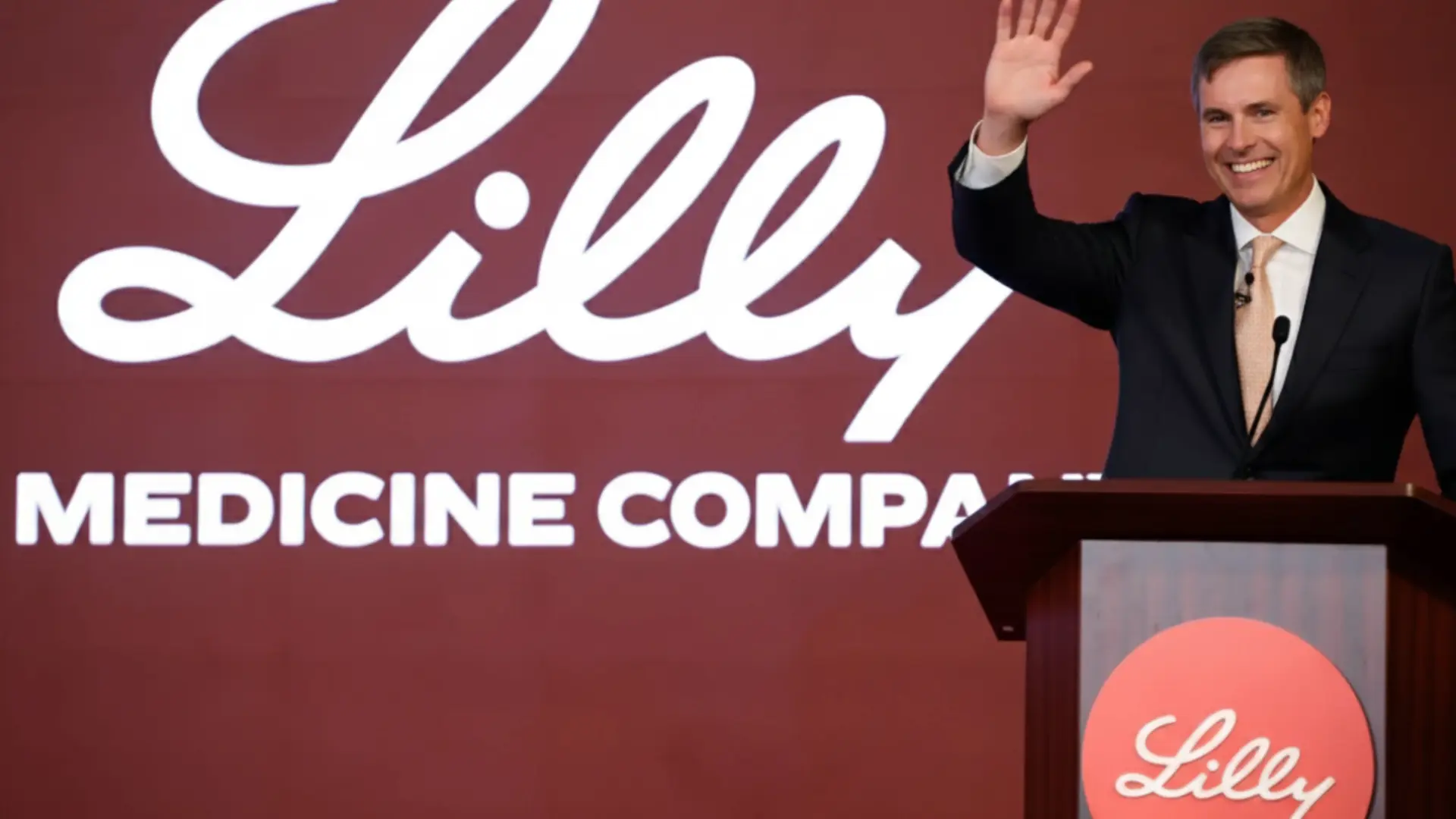
Eli Lilly just dropped earnings so juicy, they could make a salad jealous—third-quarter revenue hit $17.6 billion, smashing Wall Street’s $16 billion guess like a piñata at a diet party. And in a move that’s got investors grinning wider than a post-Zepbound mirror selfie, the pharma powerhouse bumped its full-year outlook to $63-63.5 billion, shrugging off tariff threats like yesterday’s carbs.
The numbers tell a tale of triumph in the GLP-1 arena, where Eli Lilly’s Mounjaro and Zepbound are flexing harder than a gym bro on leg day. Mounjaro alone hauled in $6.52 billion, a 109% leap that left analysts clutching their spreadsheets in awe—way above the $5.51 billion they penciled in.
Zepbound, the newbie that’s barely two years old, didn’t just show up; it crashed the party with $3.59 billion, up 184% and edging out expectations by a whisker. It’s like the drug arrived fashionably late and immediately stole the spotlight, making everyone wonder if it’s got its own agent.
Shares perked up over 2% Thursday morning, as if Wall Street itself decided to skip the donuts. Adjusted earnings per share clocked in at $7.02, dwarfing the $5.69 forecast—because nothing says “mission accomplished” like turning red ink into green envy.
But hold the kale smoothies; there’s a shadow lurking in the form of President Trump’s tariff tango. Lilly’s guidance bakes in current duties but politely ignores his pharma import threats, as if saying, “We’ll cross that border when we get to it.” It’s a reminder that even in this booming market, geopolitics can sneak up like an extra slice of pizza.
U.S. sales surged 45% to $11.3 billion, fueled by a 60% volume spike in prescriptions—folks are lining up for Mounjaro and Zepbound like it’s Black Friday at the bakery clearance aisle. Prices dipped a bit, but who cares when demand’s hotter than a jalapeño smoothie?
Net income? A whopping $5.58 billion, or $6.21 per share, versus last year’s more modest $970 million yawn-fest. Excluding the usual accounting acrobatics, that $7.02 per share adjusted figure shines brighter than a fresh pair of skinny jeans.
Eli Lilly’s not just riding the wave; it’s building the surfboard. They’ve snagged majority market share from arch-nemesis Novo Nordisk, thanks to slick injections and a direct-to-consumer push that’s smoother than a weight-loss testimonial. Yesterday, they teamed with Walmart for in-store pickup of discounted Zepbound vials—because nothing screams “convenience” like grabbing your slim-down serum next to the chips.
The real mic-drop moment? Lilly’s pinning hopes on orforglipron, their experimental obesity pill that’s got the competition scrambling like squirrels in a nut shortage. While Novo and others hustle with their own pills and injections, Lilly’s betting this little guy will lock in dominance faster than you can say “pass the measuring tape.”
Lilly’s volume boom hints at a cultural shift: more folks ditching diets for science-backed shortcuts, turning “battle of the bulge” from cliché to cash cow.
Yet, as revenue rockets 54% year-over-year, one can’t help but chuckle at the irony of drugs named after mountains and tiramisu helping folks climb down from holiday feasts. Eli Lilly’s playbook—innovation meets accessibility—positions them as the unlikely heroes in America’s waistline war.
Investors, ever the optimists, are toasting this outlook hike from $60-62 billion, with adjusted profits now eyed at $23-23.70 per share. It’s a forecast so rosy, it might need its own shade of lipstick.




Leave a Reply